Services
Custom software development.
End-to-end development of bespoke software solutions designed to streamline operations, enhance productivity, and drive digital transformation.
100% IP OwnershipNo Vendor Lock-inScalable microservices architecture
Custom Software
Web & Mobile
AI Systems
Network & IT
What's included
What you actually get
100% IP Ownership
The code, the schema and the deployment configuration are yours. We hand over the repository, not a licence to it.
No Vendor Lock-in
Standard languages, standard databases, standard hosting. Another team can pick this up without calling us first.
Perfectly aligned with your workflows
We map how the work is done today before we design anything, so the software fits the process rather than replacing it by force.
Scalable microservices architecture
Services split along real business boundaries, so the parts under load can grow without dragging the rest of the system with them.
How it works
Four steps, in the open
01
Scope
We map the problem, the users and the constraints.
We map the problem, the users and the constraints, then write down what v1 will and won't include.
02
Design
Data model and service boundaries.
Data model, service boundaries and screens you can click before we build them, so changes stay cheap.
03
Build
Working software every week.
Working software on a staging URL every week. You see progress in the product, not in a status report.
04
Ship & hand over
Deploy, monitor, transfer.
Deploy, monitor, transfer the repository and the pipeline, and stay on through the settling-in period.
Tech stack
Boring tools, chosen deliberately
We pick technologies that a future team can hire for — widely used, well documented, and something we run in production ourselves.
Application
TypeScript across the stack, so the same types describe the API on both sides of the wire.
Data
PostgreSQL with versioned migrations. The schema is in the repository, never only on a server.
Services
Containerised services with an OpenAPI contract that the build validates on every merge.
Delivery
Typecheck, lint, build and test gate each merge, and the rollback path is known before we deploy.
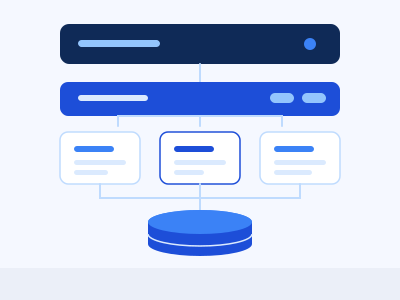
"Layered services over one owned database."
FAQ
Questions we get asked first
Who owns the code at the end?
You do, entirely. The repository, the database schema and the deployment configuration transfer to you, and there is no runtime licence or hosted component you have to keep paying us for.
What happens if we want to move to another team?
Nothing breaks. We use widely-known languages and standard infrastructure precisely so another team can take over, and the documentation and pipeline go with the code.
Do we have to know our full requirements up front?
No. Scoping is the first step, and its output is a written v1 boundary — what's in, what's out, and what we've deliberately deferred.
Can you work with the systems we already have?
Usually yes. We start by reading the existing data and integration points, then design the new services around them, rather than assuming a clean replacement is the right answer.
Other services
Web & Mobile Application Development
Creating intuitive, fast-loading web and mobile applications with cutting-edge technologies for exceptional user experiences.
AI Systems & Integrations
Leveraging artificial intelligence capabilities including RAG pipelines, multi-agent orchestration, and LLM integrations.
Network Services & IT Solutions
Designing and implementing robust network infrastructure, cloud strategies, and scalable IT architectures.